

Setup Guide
Welcome to the GSI Hyper P1. This guide will help you mount, connect and set up your Hyper P1 so you can get racing quickly and confidently.
Downloads

Wheel Layout
Get familiar with your Hyper P1.


- 1 Thumb Encoders ×4
- 2 4.3-inch Touchscreen Display
- 3 RGB Telemetry Strip 3+14+3
- 4 7-Way Switches ×3
- 5 RGB 5-Way Encoders ×5
- 6 RGB Buttons ×12
- 7 Silicone Handles
- 8 Top Paddles ×2Upgrade shown
- 9 70 mm Bolt Pattern (PCD) AH50 hub shown
- 10 N52 Magnetic Shifters ×2
- 11 Coiled Cable Connector
- 12 HSE Clutches ×2
Mount & Connect
The first step in setting up your GSI wheel is to mount it properly to your wheel base, then connect it to your PC.
Which holes does your hub or quick release have on its wheel-facing side?
Threaded holes
Use an AH50 or AH100 Hub
A hub or quick release that's threaded on its wheel-facing side can't fasten straight to your Hyper P1. Put a GSI AH50 or AH100 hub in between: its unthreaded side fastens to the wheel, and your quick release fastens to its threaded side. You never have to open the wheel.

70 mm bolt pattern
Mount Your QR/Hub
- 1Fasten your quick release to the threaded side of the AH50 or AH100 hub, with your quick release's screws.
- 1Line up your hub or quick release with the 70 mm bolt pattern (PCD) on the back of the wheel.
- 1Place the AH50 or AH100 hub's unthreaded side on the back of the wheel, GSI logo up, lining up its six holes with the 70 mm bolt pattern (PCD).
- 2Fasten it with six M5 screws through the hub or quick release into the wheel, after checking their length against the notice above. Tighten them in a star pattern with a 4 mm Allen key.
- 2Fasten the hub with the six M5 x 12 mm screws that come with it. Tighten them in a star pattern with a 4 mm Allen key.
Screws for your hub don't come with the Hyper P1. Use the ones that came with your hub or quick release, once they pass the check above.
Leave at least 50 mm between the wheel and your wheel base, so the coiled cable never touches the base.

Coiled USB Cable
Connect to PC
Quick release has a USB-C cable? Switch
- 3Put the wheel on your wheel base.
- 4Connect the cable to the Coiled Cable Connector, lining up the keyed portion with the connector.
Coiled USB Cable
Connect the Other End


- 5Connect the other end to your powered USB hub.
- 5Connect the other end to a USB port on your PC.
Software Setup
Install simOS and follow the steps below.
How will you run your Hyper P1?
You can change this later.
On your PC
Install simOS
simOS is the GSI app. You need it to finish setting up your Hyper P1.
- 1Download simOS and install it on the PC your Hyper P1 connects to.
- 2Open simOS. Its setup comes first: see Set Up simOS below.


In simOS
Set Up simOS
- 3The first time simOS opens, it asks Who drives your wheel's lights and screen? Click SimHub.
- 3The first time simOS opens, it asks Who drives your wheel's lights and screen? Click simOS.
- 4In Install Components, leave the selection as it is: the required components, SimHub and SimHub Device Profile are already ticked.
- 4In Install Components, leave the selection as it is: the required components are already ticked, and SimHub isn't.
- 5Click Install. When simOS shows You're all set!, click Close.
While SimHub installs, Windows asks for administrator permission. Click Yes before the prompt closes by itself, after about two minutes.

In simOS
Find Your Hyper P1
- 6Look under Your devices on Home. The Hyper P1 (Rev B) tile reads Connected.
- 7Click the Hyper P1 (Rev B) tile to open its device page.
An older Hyper P1 shows as Hyper P1 (Rev A).

In simOS
Update Firmware
- 8Go to the Firmware tab.
- 9If an update is available, click Update now.
- 10Wait for the wheel to restart. simOS then shows the new version.
Update stuck on Preparing Device, or simOS says recovery mode? See Troubleshooting.

In simOS
Test Your Controls
- 11Go to the Input test tab.
- 12Press every button and move every paddle, encoder and switch. Each one shows on the tab as you use it.
In your game
Map Your Controls
Your wheel base and its software still handle steering and force feedback. Your Hyper P1 is a controller of its own: map its buttons, paddles, encoders and switches in each game's controls menu.
- 13Open your game's controls menu.
- 14Pick an action, then press the button, pull the paddle or turn the encoder you want for it.
- 15If your Hyper P1 has 4 paddles (the optional dual clutches), mapMap the clutch paddles to your game's clutch. In Launch Control and Dual Clutch modes, the two paddles work as one clutch axis. For the other modes, see Clutch Modes.
Not sure which control is which? The Input test tab in simOS shows each one as you use it.
SimHub Setup
simOS + SimHubYou chose simOS + SimHub. Set SimHub up here, so simOS and SimHub never fight over the same part of the wheel.
Skipped SimHub when you set up simOS? Download SimHub, then add the GSI Companion plugin in the next step.

In simOS
LEDs and Display
- 1On the General tab, set LED source to Auto. simOS runs the LEDs and hands them to SimHub while SimHub is running.
- 2Check the line under it. It reads The GSI Companion plugin is installed in SimHub. If it doesn't, install or update the plugin from that line.
- 3To run a SimHub dash, turn Display output off on the Display tab. SimHub can then use the display.
- 3Once the Hyper P1 dash for SimHub is out, turn Display output off on the Display tab to run it. SimHub can then use the display.
Only one app can use the display at a time.

In SimHub
Add Your Hyper P1
- 4Open SimHub and go to Devices.
- 5Click Add device in the middle of the page. If SimHub already lists other devices, click Add new device at the top of the page instead.
If you're experiencing issues, make sure you're running the latest version of SimHub. Then, delete your device from SimHub and start again from step 4.

In SimHub
Select Your Hyper P1
- 6Select GSI Hyper P1 under Devices found on your system and click Ok.

In SimHub
Check the LED Profile
- 7On the LEDs tab, Telemetry Leds already uses GSI Hyper P1 - Telemetry - simOS Companion Ready. Leave it selected.
SimHub still not lighting the wheel? Check the GSI Companion line on simOS's LED source card, and install or update the plugin.

In SimHub
Import the Hyper P1 Dash
- 8Download the Oswald font. Extract Oswald.zip, select all files, then right-click and install.
- 9Download the Hyper P1 Dash. Open the file to import it into SimHub.
- 10Download the Config Overlay Dash and import it the same way. See Config Overlay Dash for how to use it.
Enjoy your Hyper P1
Setup Complete
Your Hyper P1 is ready to race. Everything below is optional.
Something not working? Check Troubleshooting for fixes to common problems.

Explore
Get to know your Hyper P1.
Your Hyper P1 is ready to race. Pick a feature to see what it does and how to set it up.
General tab · Clutch card
Clutch
Your Hyper P1 comes set to Launch Control, the default clutch mode on every GSI wheel. Using the clutches is up to you and the car you drive. See Clutch Modes for what each mode does.
- Pick a mode in the Mode list of the Clutch card.
- For Launch Control or Dual Clutch, set the Bite point.
- For Dual Clutch, choose the Master clutch: Left or Right.
- Click Save to wheel. Unsaved changes are lost when the wheel restarts.

General tab · Encoders and Smart Controls cards
Encoders & Buttons
- Press timing: on the Encoders card, set each RGB 5-way encoder to On Push or On Release. See Encoder Settings.
- Front button modes: on the Smart Controls card, click Edit buttons, give any front button a mode such as Toggle, then click Save to wheel.
- Check each change on the Input test tab.

LEDs tab
LEDs
Your Hyper P1's LEDs: the RGB Telemetry Strip (3+14+3), the 12 RGB Buttons and the RGB 5-way encoders.
- If the tab says telemetry processing is off, turn on Enable telemetry processing.
- Under Base lighting, pick a solid color or a colorway.
- Choose a Color theme and which Essential driving alerts may light the wheel.
- For full control, switch to Advanced and turn rules on or off on the Rules tab.
simOS runs the LEDs while LED source on the General tab is set to Auto or simOS. To let SimHub run them, choose simOS + SimHub in Software Setup.

Display tab
Display
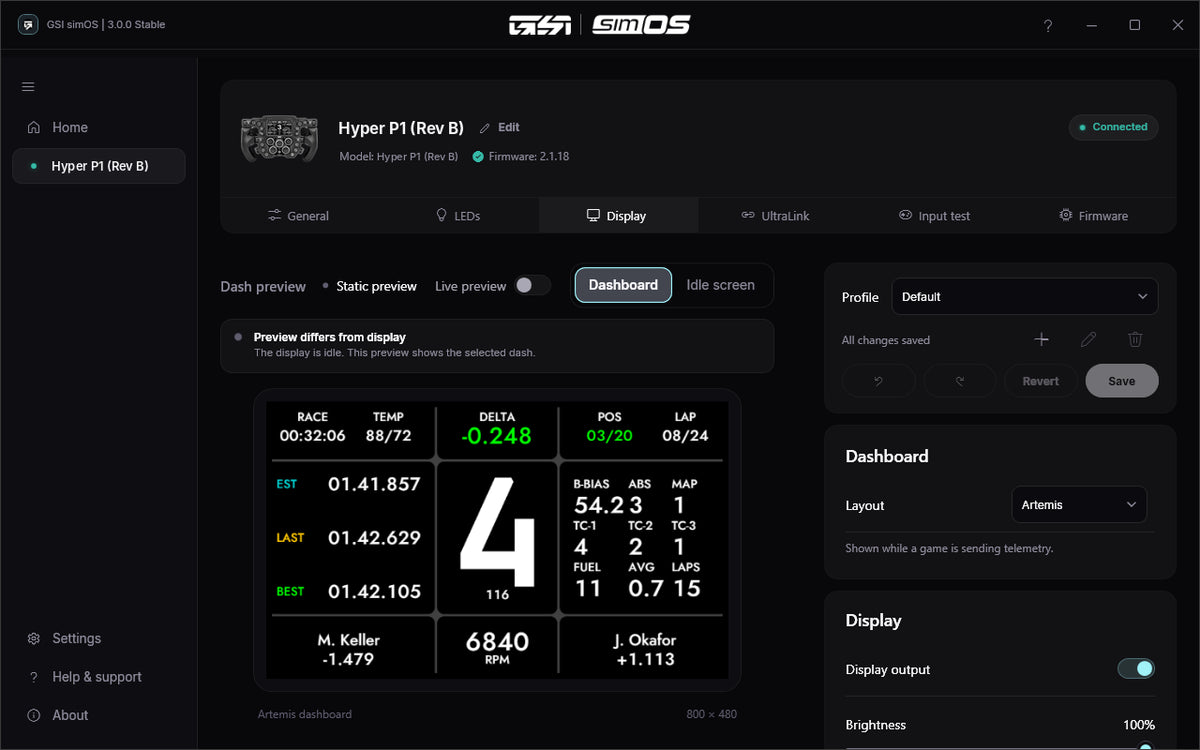
simOS runs the 4.3-inch Display. Any dash layout can be selected, and the one you pick shows whenever a game sends telemetry.
- Make sure Display output is on.
- If the tab says telemetry processing is off, turn on Enable telemetry processing.
- Under Dashboard, pick any Layout and, where offered, a Colorway.
- Under Display, set Brightness and Frame rate.
- Under Idle screen, choose what shows when no game is running.
Prefer a SimHub dash? Choose simOS + SimHub in Software Setup.
General tab · Clutch card
Clutch Modes
Only if your Hyper P1 has 4 paddles (the optional dual clutches).
Choose how the clutches work in the Mode list of the Clutch card, on the General tab. Launch Control is the default.
Used to get the fastest launch off the line. Each clutch has its full range until you launch: release either clutch, and the other one holds the bite point.
How to use
- Select Launch Control in the Mode list.
- Set a Bite point that corresponds to your vehicle, then click Save to wheel. You can find it by revving the engine in first gear, then slowly releasing the clutch until you find the most acceleration without wheel slip.
- Pull both clutches and rev the engine to the specific RPM that maximizes acceleration off the line, but minimizes wheel spin.
- Release either clutch and slowly release the remaining depressed clutch to maximize acceleration.
There is no one size fits all for this procedure, since clutch bite points vary per vehicle and even per session. Be sure to experiment and practice for the best results.
Used to get the fastest launch off the line. The master clutch has the full range; the other one stops at the bite point.
How to use
- Select Dual Clutch in the Mode list.
- Choose a Master clutch (Left or Right). The master clutch outputs the full range from 0 to 100%.
- Set a Bite point that corresponds to your vehicle, then click Save to wheel.
- Pull both clutches and rev the engine to the specific RPM that maximizes acceleration off the line, but minimizes wheel spin.
- Release the master clutch and slowly release the bite point clutch to maximize acceleration.
There is no one size fits all for this procedure, since clutch bite points vary per vehicle and even per session. Be sure to experiment and practice for the best results.
Used to map two individual inputs that range from 0 to 100%.
Within your game, map each clutch to the control you want. No additional setup is required.
Use examples
Used to map two individual inputs with on/off behavior.
Within your game, map each clutch to the control you want it to press. No additional setup is required.
Use examples
Teaches the wheel the full travel of your clutches.
Select Calibration, move both clutches all the way, then choose another mode.
The clutches produce no output signal.
Change clutch settings without leaving the sim
Config Overlay Dash
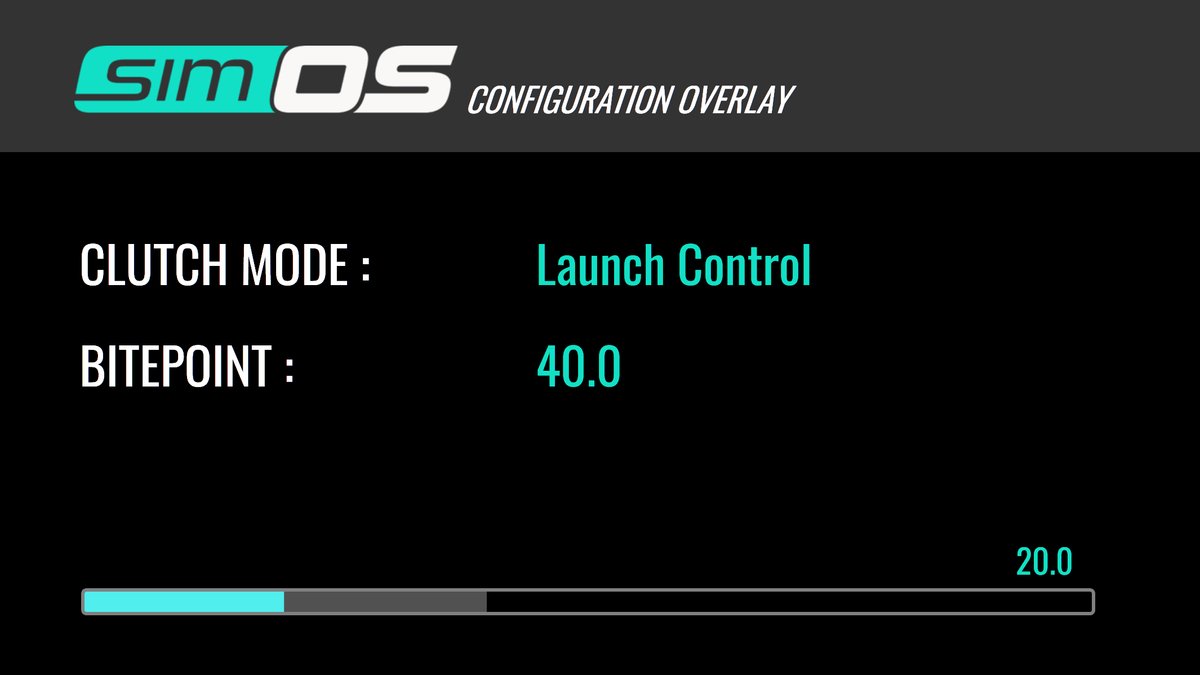
Shows and changes the active clutch mode and the clutch bite point. It works only when SimHub runs the display (simOS + SimHub), with the Config Overlay Dash imported: see Import the Hyper P1 Dash.
- Push and hold the top left and top right 5-way encoders to open it.
- Press up or down on any 7-way switch to change the clutch mode.
- Turn the top three 5-way encoders left or right to set the bite point.
- Press any push button to close it.
Bite point steps
General tab · Encoders card
Encoder Settings
Each RGB 5-way encoder works as a rotary knob and as a push button. Set its press timing on the Encoders card of the General tab, and check it on the Input test tab.
On Push
Acts as a regular button, pressed for as long as you hold it.
For example, you could map it to an engine starter, which requires you to push and hold until the engine starts. This isn't possible with On Release.
Supported inputs
On Release
Sends a short pulse when you let go, unless you turned the encoder.
With UltraLink off, pushing and turning the encoder sends separate inputs, in addition to the regular turn inputs. This effectively makes it two rotaries in one. UltraLink uses these inputs, so they aren't available while UltraLink is on.
Supported inputs
simOS
Other Settings
Encoder Pulse WidthControls how long the signal remains active once an encoder is rotated (5-Way Encoders, 7-Way Switches, Thumb Encoders).
By default, this is set to 30 ms as it provides a good balance between responsiveness and accuracy for each click in the rotation. Some titles may require this setting to be set higher in order to be detected reliably.
If you encounter this issue, increase the value by 10 and save it. Test within the title again and repeat until the issue is resolved.
LED BrightnessControls overall LED brightness for RGB backlit elements.
GSI wheels are set to the lowest brightness setting by default to prevent power throughput issues. If you're using a powered USB hub, you can safely use higher brightness settings. If you experience disconnects, your wheel may not be receiving enough power.
Wheel TypeChanges the wheel input mapping and identifier for all GSI wheel models.
Only change this if the wheel shown in simOS doesn't match the wheel in your hands. The steps are under "simOS shows another wheel model" in Troubleshooting.
Pro tips and tricks directly from the GSI production team
Cleaning & Maintenance
General Cleaning
- Before cleaning, unplug the wheel's USB cable.
- Use a soft microfiber towel lightly dampened with 99% isopropyl alcohol to gently wipe the wheel.
- Use a soft detailing brush to remove debris from hard-to-reach areas.
Pro tips from the GSI production team
Shifter Care
GSI shifters come lubricated from the factory. With extended use, put a small amount of PTFE lubricant back on the two spots in the drawing to keep them working at their best.
- Don't use spray lubricants or too much lubricant.
- Keep the lubricant off the rest of the wheel.

Pro tips from the GSI production team
Clutch Care
- Maintenance: put PTFE lubricant on the spring resting points inside the clutch housing to keep the clutch smooth.
- Adjustment: with a 2 mm Allen key with a stubby end, loosen (don't remove) both screws on both ends of the clutch until the retention paddle moves freely. Set it where it feels comfortable, then tighten both screws again.

Troubleshooting
Find what you see and open it for the fix.
simOS setup says it completed with errors
A step needed Windows administrator permission and didn't get it, usually because the Windows prompt closed by itself after about two minutes.
- Click Retry failed steps.
- When Windows asks, click Yes.
Already closed setup?
- Go to Help & support and click Troubleshoot.
- Pick Set up SimHub or Set up simOS, then click Run checks.
- On each row that shows a problem, click its button, such as Install.

The Hyper P1 isn't under Your devices in simOS
- Close simOS.
- Check the cable.
- Open simOS again with the wheel plugged in.
Still missing? Try a USB port on the back of your PC. More help: Wheel Not Detected.
The wheel drops out or reconnects by itself
Take out any USB extension cables and try a port on the back of your PC. With the coiled cable, connect through a powered USB hub. The list below has more. More help: Steering Clear of Disconnects.
Buttons work, but the display and LEDs stay dark
Your quick release may carry only button signals. The display and LEDs need one that carries USB data: check its maker's specs. Then open the Display tab and check that Display output is on.
Buttons work, but the display and LEDs stay dark
Your USB port may not give the wheel enough power: connect through a powered USB hub. Then open the Display tab and check that Display output is on.
Buttons work, but the LEDs stay dark
Your USB port may not give the wheel enough power: connect through a powered USB hub.
The wheel still drops out after trying the fixes above
The wheel needs a clean, steady USB signal and no electromagnetic interference (EMI) from other devices. Try these:
- Connect the wheel through a powered USB hub.
- Avoid long USB extension cables: data degrades over long extensions.
- Some AMD systems have known USB problems: update your motherboard's BIOS to AGESA 1.2.0.2 or later. The update is on your motherboard maker's website.
- Check for EMI from other devices, and ground your rig if needed.
- If one USB port isn't working well, try another.
- If you use the coiled cable, check that its housing is screwed on tight.
- Every USB device on your PC shares the same data bandwidth. Make sure you aren't overloading it.
- Use a dedicated PCIe USB card. We recommend one with an NEC chipset.
A firmware update stays on Preparing Device
- Keep the wheel plugged in.
- In simOS, go to Settings > Updates and check that Clear driver conflicts is on.
- If a Windows administrator prompt appears, approve it.
- Click Update now again.
More help: Update Stalls on Preparing Device.
simOS says the wheel is in recovery mode
- Open the Firmware tab.
- In the Wheel model list, pick Hyper P1.
- Click Save and restart.
If it keeps coming back, open a support ticket.
simOS shows another wheel model
Right after an update, simOS asks "Not the …?": pick Hyper P1 in the list and click Update. Otherwise, change it yourself:
- Go to Settings > Advanced and turn on Advanced mode.
- Open the Hyper P1 device page, go to the General tab and scroll to the Developer tools card.
- In the Wheel type list, choose Hyper P1. The wheel restarts, and the Model line in the header then reads Hyper P1.
More help: Change Wheel Type. Still the wrong model? Open a support ticket.
A control doesn't show on the Input test tab
Update the firmware first: see Update Firmware. Still missing? Open a support ticket.
A control shows on the Input test tab, but not in your game
Map it in your game's controls menu: see Map Your Controls.
To check what Windows sees:
- Press Win + R, type joy.cpl and press Enter.
- Check that the wheel appears and responds when you press its buttons.
The encoder rings don't show the mode
Turn on UltraLink, then turn on that encoder on the UltraLink tab. See UltraLink.
The lights or screen don't work in game
simOS can check this for you.
- Go to Help & support and click Troubleshoot at the top right.
- Pick Lights or screen don't work in game as the problem.
- Pick the app that should drive them: simOS or SimHub.
- Click Run checks. Each check shows OK, a warning or a problem.
- On a row with a problem, click its button, such as Choose game or Start SimHub. Or click Fix all.
Fix all never updates firmware: click Update firmware on its own row for that. To set up SimHub or simOS again, pick Set up SimHub or Set up simOS in step 2 instead.

The LEDs ignore simOS
On the General tab, check LED source. On Auto, SimHub takes over the LEDs while it runs.
simOS says another program is using the display
Only one app can use the display at a time, usually SimHub. Close it or turn off its output to the wheel: simOS takes the display back by itself, or click Use this display.
The display flickers, tears or freezes
On the Display tab, set the frame rate to 30 FPS and lower the brightness. More help: USB Screen Needs.
Still stuck?
Our support team can troubleshoot with you. Open a ticket in the GSI Support Center.
Safe Usage & Warranty
For more information, read the full Terms of Service.
Warnings & instructions for safe usage
- Never use damaged or in any way defective product, stop using it and contact the reseller or the manufacturer.
- Use protective gloves when changing or adding parts to the steering wheel, or when removing parts from it.
- Always make sure everyone using the GSI steering wheel has read and understood this guide.
- Always check that all connections and quick releases are tightened before using the steering wheel.
- DO NOT open the steering wheel.
- The GSI steering wheel or any of its parts may not be used for any other purpose than what they were designed for. GSI products are meant to be used as a USB input device on a computer. DO NOT USE IN A REAL CAR! The manufacturer is not liable for any damage that may result from using the product in violation of the instructions.
- The GSI steering wheel must be securely fastened to the wheel base to handle the forces wheel bases generate. It is the user's responsibility to ensure that the platform can withstand the use of the GSI steering wheel.
Operating environment and safe storage conditions
- 15°C – 35°C (59°F – 95°F) temperature, non-condensing humidity.
- Do not expose the GSI steering wheel or any provided parts to direct sunlight or moisture.
- Indoor use and storing only.
Warranty
The product has a warranty of 12 or 24 months depending on region, excluding situations and events where:
- Instructions for use or care have been disregarded.
- The product has been used incorrectly or carelessly.
- An accident or other event has occurred after the product has been handed over, in which the product has been damaged by external factors.
- Normal wear and tear in use.
CE-Marking
Product meets EU standards for health, safety, and environmental protection.
Manufacturer: Gomez Sim Industries LLC
Manufacturer address: 1167 Mississippi Ave #100, Dallas, Texas 75207